Monday, June 30, 2014

Wednesday, October 17, 2012
Building a Sewing Table
I was inspired by the documentary “We the Tiny House People.” http://www.youtube.com/watch?v=lDcVrVA4bSQ
After seeing the creative things people did with very little space, I realize I have plenty of space. I just need to utilize it better. Below is the before picture, but not entirely. This is after I tossed out some things, bought rolling carts, and stuffed the rest of the sewing projects into the rolling carts.

I went off to hardware land (Home Depot and Lowes elbow to elbow). I was in search of something to use as a table top. At Lowes I found “laminated project panels.” I went off to look for table legs when I spied pine 1x2s—light bulb. I’d make the legs out of 1x2s. I jotted notes and skipped home to draw up plans.
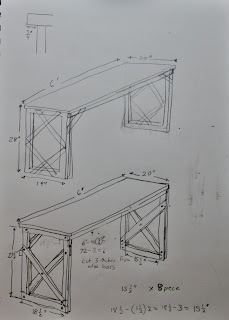


I’m using scrap wood from the garage to try out how it will go together. I’m quite pleased that I’ve cleared off my drafting table. And I’m finding that the roll of brown paper which I’ve been using for sewing patterns is just the right size. I just unroll more when I need it.


Then off to hardware land again to buy the materials. Sorry no pictures. While there I realized I might as well make two tables, so I bought 14 8’ lengths of pine 1x2s, 2 6’ lengths, and two project panels. While headed out I noticed a young man laying out pieces of wood. He was designing a pirate’s treasure chest to use with kids at his church, such fun.

I’m checking the height of the table for sewing. I’ve got the table top on the rolling chest and propped up with 2x4s. You can’t see the 2x4s, because I’ve clamped the lip of the table in place. I’m making sure I’ve got enough clearance underneath.
Back to the drawing board.

I changed the dimensions and so had to redraw the layout. Notice the paper weights. These are cans from Michael’s crafts filled with my rock collection. When I bought the cans I didn’t know they would make such excellent paper weights.
I had to stop here because high winds were forecast. I had to get the apples off my tree before the wind did the job for me. I also need to process blueberries and raspberries before mold beat me to it.
After seeing the creative things people did with very little space, I realize I have plenty of space. I just need to utilize it better. Below is the before picture, but not entirely. This is after I tossed out some things, bought rolling carts, and stuffed the rest of the sewing projects into the rolling carts.

I went off to hardware land (Home Depot and Lowes elbow to elbow). I was in search of something to use as a table top. At Lowes I found “laminated project panels.” I went off to look for table legs when I spied pine 1x2s—light bulb. I’d make the legs out of 1x2s. I jotted notes and skipped home to draw up plans.


I’m using scrap wood from the garage to try out how it will go together. I’m quite pleased that I’ve cleared off my drafting table. And I’m finding that the roll of brown paper which I’ve been using for sewing patterns is just the right size. I just unroll more when I need it.


Then off to hardware land again to buy the materials. Sorry no pictures. While there I realized I might as well make two tables, so I bought 14 8’ lengths of pine 1x2s, 2 6’ lengths, and two project panels. While headed out I noticed a young man laying out pieces of wood. He was designing a pirate’s treasure chest to use with kids at his church, such fun.

I’m checking the height of the table for sewing. I’ve got the table top on the rolling chest and propped up with 2x4s. You can’t see the 2x4s, because I’ve clamped the lip of the table in place. I’m making sure I’ve got enough clearance underneath.
Back to the drawing board.

I changed the dimensions and so had to redraw the layout. Notice the paper weights. These are cans from Michael’s crafts filled with my rock collection. When I bought the cans I didn’t know they would make such excellent paper weights.
I had to stop here because high winds were forecast. I had to get the apples off my tree before the wind did the job for me. I also need to process blueberries and raspberries before mold beat me to it.
Saturday, July 21, 2012
Antigone and The Hunger Games
My niece and nephew have been acting in plays put on by TBA Theater.
As a good aunt I buy tickets and attend the shows, usually wonderful
productions which showcase the talents of young actors and actresses. On Friday
watched Antigone, a TBA show which my young relatives weren't in. They sat next
to me. Wow! What a powerful show. I was particularly impressed by the portrayal
of Creon, the leader of Thebes. Antigone was originally written by Euripides, a
contemporary of Socrates, back in the fifth century BC. That play has been
mostly lost but Sophocles wrote another version also in the fifth century BC. The
Antigone put on by TBA was based on a play written by Jean Anouilh in the 1940s.
Earlier this week on Tuesday I watched the movie The Hunger
Games, also an excellent show. As I stood in line to get in every teenager I
spoke with had already seen the movie and was going back to watch it again.
Teenagers love this movie.
It occurred to me that The Hunger Games and Antigone have
nearly the same plots. They both occur in the aftermath of a rebellion. To put
down the rebellion and intimidate the populace, civil authorities decide to
stage an intimidating spectacle. In Antigone, this spectacle is a man's body
left to rot out in the town square. In The Hunger Games it's the televised
sacrifice of young people from outlying provinces. Along comes the heroine who
in both dramas lives with her sister after the death of their father. The
heroine, for personal reasons, defies the edict with the full expectation that
she will die for doing so. In the interest of maintaining public order, civil
authorities can't or won't relent. Antigone is condemned to being buried alive.
Katniss, heroine of The Hunger Games, is condemned to . . .well you'll have to
see the movie. Then Antigone takes her own life and the man who loves her takes
his own life as well. In the play by Euripides , this double suicide is
miraculously averted, making the ending of both dramas nearly the same. Both
dramas are tragedies with lots of dead bodies.
I view the ancient Greeks as the originators of speculative
fiction, what is sometimes called social science fiction, or dystopian science
fiction or, as Margaret Atwood labels it, ustopia. Those who write such fiction
follow in the footsteps of Plato in designing an imaginary society and using it
to examine the relationship between the state and the individual, but most of
all to tell a good story. Sir Thomas Moore continued this tradition in 1516 with
his Utopia. And now here is Collins with The Hunger Games once again getting
young people thinking, asking questions, and talking just as Socrates did back
in the fifth century BC. With the TBA production
of Antigone, we have young people not engaging in Socratic thinking, but doing
powerful interpretations of Greek tragedy. I am delighted that young people are
interested in such dramas and in such discourse. It gives me much hope for the millennial
generation and for the future.
Friday, June 1, 2012
Neighborhood Enclaves
During my morning walk, I strolled into a cul-de-sac of duplex houses. Following a footpath worn in the grass of a backyard, I discovered a break in a fence and a trailer court which I'd never explored before. The trailer court has a chain link fence all the way around the perimeter. This fence certainly hadn't kept me out. Judging from the path worn in the grass, I suspect that the break is used primarily by trailer court residents walking to the grocery store.
Outside the fence were both the duplexes and a row of those breeder-box snout houses, the kind with small yards, gray T1-11 siding and, in the front, a garage--not all that different from my house actually.
I was thinking that the fence was an example of how people of different socio-economic strata isolate themselves in their own neighborhood enclaves, snout-house residents and duplex residents, not associating with trailer-court residents. Then I noticed the barbwire atop the fence angled outward. So, it seems the trailer court residents were keeping out the snout-house and duplex riff-raff. In most places the fence crossed the snout-house backyards keeping out only the children who might be playing there. Odd. Then it must be the owner of the trailer court who put up this barbwire-topped fence in some mistaken idea of safety. I think management of the trailer court should remove the barbwire. It's offensive, doesn’t actually do anything, and might have some value as scrap. Let's hear it for recycling.
Wednesday, May 30, 2012
submission and Dominance
I've been told that inequality in sexual relationship is unhealthy and even evil. Despite this I still find submission appealing, and situations of dominance and submission seem to appear in much of my fiction. Judging from literature, imagery, and cinema, many people, maybe even most people find submission to be erotic. It's not rational preference but an emotional and physical reaction to the idea of submission, pain, and suffering. These images and ideas include the passion and crucifixion of Christ.
I find I'm attracted to submission but not to sadism. For me, the ability to relieve pain and suffering is far more powerful emotionally than the ability to cause pain. I was married for seven years to a man I dearly loved and who died of a painful hereditary disorder. He spent the last three years of his life in constant unbearable pain. I allowed him to take the dominant role in sexual play and this delighted me. I could give him for a brief time the ability to control pain, something which medical personnel and religious practitioners couldn't do as much as they tried.
For me, my love for my husband was, and still is, a powerful emotional cocktail made of faith, sorrow, compassion, pain, and eroticism. It still brings tears to my eyes. I cry nearly every time I receive the holy Eucharist or follow the Stations of the Cross.
For me willing sacrifice in order to relieve suffering is sacramental. It is also erotic and so is the biblical teaching to submit to one's spouse. I'm not sure where my attitude puts me in relationship to feminism and to traditional Christianity. It may put me as blasphemous to both.
I find I'm attracted to submission but not to sadism. For me, the ability to relieve pain and suffering is far more powerful emotionally than the ability to cause pain. I was married for seven years to a man I dearly loved and who died of a painful hereditary disorder. He spent the last three years of his life in constant unbearable pain. I allowed him to take the dominant role in sexual play and this delighted me. I could give him for a brief time the ability to control pain, something which medical personnel and religious practitioners couldn't do as much as they tried.
For me, my love for my husband was, and still is, a powerful emotional cocktail made of faith, sorrow, compassion, pain, and eroticism. It still brings tears to my eyes. I cry nearly every time I receive the holy Eucharist or follow the Stations of the Cross.
For me willing sacrifice in order to relieve suffering is sacramental. It is also erotic and so is the biblical teaching to submit to one's spouse. I'm not sure where my attitude puts me in relationship to feminism and to traditional Christianity. It may put me as blasphemous to both.
Saturday, December 31, 2011
Kuspuk Making: The Pattern
Several years ago, a co-worker had offered to teach a class in kuspuk making and I bought fabric to make one. The class didn't happen. I've had three or so yards of lovely batik fabric just waiting. The color is sort variegated blue and gold and reminds me of tundra in August.
A kuspuk is a traditional Alaskan woman's summer parka with a hood and, around the bottom, a sort of ruffle or peplum. A kuspuk is to Alaska what an aloha shirt is to Hawaii. They're usually made out of calico with commercial braid used for trim. The hoods are usually close fitting to keep mosquitoes off. Even though they are called "summer parkas," they are often worn indoors year round and are used by Native dance troops. They're easy and inexpensive to make and cool enough to be worn inside while engaged in vigorous activity.
I remembered buying a pattern as well and went through every one of my sewing drawers.
Nope. Had to buy one. I went to four stores before I found a kuspuk pattern available. Apparently kuspuk making has been a popular activity this Christmas and "Kuspuk Pattern by Lois" put out my Alaskan Patterns seems to be the one and only pattern in usage.
Unsure if I should make myself a size 16 or size 18, I made a preliminary muslin out of an old sheet. A muslin is to writing what a draft is to a novel, or a white-build to making cardmodels. A jewelry maker once told me first make it out of copper, then silver, then gold. So I made part of the kuspuk out of an old sheet. Good thing I did. The fit is horrid.
A shirt, jacket, or other such covering can be imagined as three elliptical tubes with the arm tubes intersecting the torso tube at an angle. Imagine that we've got the tubes intersect this way. We cut an arm tube open and flatten it out. The top of the arm shape now looks a bit like a sinusoidal curve. It might even be a sinusoidal curve--I'm unsure of the mathematics.
The sleeve on the kuspuk by Lois is cut nearly strait, no hint of that lovely sine wave. To make it worse this sleeve is going into an armhole which resembles a slit. This would work if she'd gone back to the old peasant method of construction with everything made out of rectangles and putting gussets under the arms. This works better with hand-sewing than machine sewing. It is nice for ironing, however, and so good for undergarments. The chemise for my regency gown is constructed in the old peasant method. This old method can be done without a pattern and without cutting. Fabric can be ripped into rectangles or woven initially as rectangles.
Some computer programs convert 3-D shapes to 2-D shapes but I use the paper, scissors, and tape method. I make a guess as to the shape, cut it out of paper, and tape it together. I make adjustments with scissors and tape until I've got those nice elliptical tubes. Then I cut it apart and retrace what I've got onto a new piece of paper. Voila a pattern.
I buy readymade patterns either when I want to understand how something is made or when I want to jump ahead in the process to the interesting parts. So with the kuspuk pattern I spent 20 dollars for Lois to figure out the shape of sleeves and hood. Very disappointing that she had skipped this crucial part of the process herself. The pattern is worthless, everything else I can easily do without any help.
I'm not sure way Lois had such a poor understanding of tailoring. I learned about sleeves by making doll clothing. I made some truly awful miniature shirts. Fortunately they were made out of scrap and so didn't cost me anything.
I looked at pictures of kuspuks on the Internet and found that this sleeve fit problem is endemic. Whole dance troops are performing with badly fitting sleeves and probably accidently ripping out the underarm seams. Lois recommends double stitching the seam under the arm, so it seems she was somewhat aware of the problem. We all seem to be camouflaging the bad tailoring by making kuspuks out of fabric printed with flowers and the like. "Tailor" is the right word since the word originates from French and means "cut."
Lois may have been a good seamstress but she was a lousy tailor.
I am now fantasizing about designing and publishing better kuspuk patterns. I can't decide if I want to do raglan or in-set sleeves.
A kuspuk is a traditional Alaskan woman's summer parka with a hood and, around the bottom, a sort of ruffle or peplum. A kuspuk is to Alaska what an aloha shirt is to Hawaii. They're usually made out of calico with commercial braid used for trim. The hoods are usually close fitting to keep mosquitoes off. Even though they are called "summer parkas," they are often worn indoors year round and are used by Native dance troops. They're easy and inexpensive to make and cool enough to be worn inside while engaged in vigorous activity.
I remembered buying a pattern as well and went through every one of my sewing drawers.
Nope. Had to buy one. I went to four stores before I found a kuspuk pattern available. Apparently kuspuk making has been a popular activity this Christmas and "Kuspuk Pattern by Lois" put out my Alaskan Patterns seems to be the one and only pattern in usage.
Unsure if I should make myself a size 16 or size 18, I made a preliminary muslin out of an old sheet. A muslin is to writing what a draft is to a novel, or a white-build to making cardmodels. A jewelry maker once told me first make it out of copper, then silver, then gold. So I made part of the kuspuk out of an old sheet. Good thing I did. The fit is horrid.
A shirt, jacket, or other such covering can be imagined as three elliptical tubes with the arm tubes intersecting the torso tube at an angle. Imagine that we've got the tubes intersect this way. We cut an arm tube open and flatten it out. The top of the arm shape now looks a bit like a sinusoidal curve. It might even be a sinusoidal curve--I'm unsure of the mathematics.
The sleeve on the kuspuk by Lois is cut nearly strait, no hint of that lovely sine wave. To make it worse this sleeve is going into an armhole which resembles a slit. This would work if she'd gone back to the old peasant method of construction with everything made out of rectangles and putting gussets under the arms. This works better with hand-sewing than machine sewing. It is nice for ironing, however, and so good for undergarments. The chemise for my regency gown is constructed in the old peasant method. This old method can be done without a pattern and without cutting. Fabric can be ripped into rectangles or woven initially as rectangles.
Some computer programs convert 3-D shapes to 2-D shapes but I use the paper, scissors, and tape method. I make a guess as to the shape, cut it out of paper, and tape it together. I make adjustments with scissors and tape until I've got those nice elliptical tubes. Then I cut it apart and retrace what I've got onto a new piece of paper. Voila a pattern.
I buy readymade patterns either when I want to understand how something is made or when I want to jump ahead in the process to the interesting parts. So with the kuspuk pattern I spent 20 dollars for Lois to figure out the shape of sleeves and hood. Very disappointing that she had skipped this crucial part of the process herself. The pattern is worthless, everything else I can easily do without any help.
I'm not sure way Lois had such a poor understanding of tailoring. I learned about sleeves by making doll clothing. I made some truly awful miniature shirts. Fortunately they were made out of scrap and so didn't cost me anything.
I looked at pictures of kuspuks on the Internet and found that this sleeve fit problem is endemic. Whole dance troops are performing with badly fitting sleeves and probably accidently ripping out the underarm seams. Lois recommends double stitching the seam under the arm, so it seems she was somewhat aware of the problem. We all seem to be camouflaging the bad tailoring by making kuspuks out of fabric printed with flowers and the like. "Tailor" is the right word since the word originates from French and means "cut."
Lois may have been a good seamstress but she was a lousy tailor.
I am now fantasizing about designing and publishing better kuspuk patterns. I can't decide if I want to do raglan or in-set sleeves.
Structural Unemployment
Listening to NPR I heard about "structural unemployment." At last! Someone talking sense about the current state of the economy. We've been looking at the economic problem wrong. It's not that we need more jobs created; we need the right jobs created.
Here is how I see the situation. We had the real-estate bubble with too many resources (labor hours) going into building houses, houses which were too big and expensive for people to pay (work) for. So the market crashed. We needed to move construction workers, real-estate agents, and mortgage brokers into jobs producing things we actually need.
That crash brought the rest of the economy down as we cut costs (labor hours) from things we actually need such as education and scientific research. Exacerbating the situation we are undergoing a shift in retail, more goods bought on the Internet and less in actual stores. We must move retail workers into new jobs.
To get back to deploring resources effectively, someone has to decide how to what we need, then borrow money to for it. We've got three groups who could make the critical decisions and take the risk. Consumers could take out loans to buy things which will make their lives better, but consumers are already carrying too much debt, and they can't buy things unless the stuff is available.
Businesses could borrow and make guesses about what consumers might. But business, like government, has been cutting costs and reducing both risk and inventory, making wanted and needed goods unavailable.
Where are you Steve Jobs? We need men and women with vision, those who understand what customers will want and are willing to take risks, take out the loans, and hire people.
That leaves the government taking the risk, but government barrowing will only work if it's backed up by vision, the understanding of what sort of investment of labor will pay off in the long run. Here is opportunity. Some necessary services can only most effectively provided by the government, services such as: education, public health, mass transportation, research, and job retraining.
But as I see it the bottom line, the things we most need as a nation are vision and courage. With these, we can put people to work doing jobs which need to be done. I think all of us: consumer, businesses, and government, should stop agonizing over cutting short term costs and instead consider long-term investment.
I'm doing my part. I went out and bought a new refrigerator. In the short term, I'm spending--gasp, pant, pant, panic--more money, but I hope in the long term it will save me money in energy costs.
Here is how I see the situation. We had the real-estate bubble with too many resources (labor hours) going into building houses, houses which were too big and expensive for people to pay (work) for. So the market crashed. We needed to move construction workers, real-estate agents, and mortgage brokers into jobs producing things we actually need.
That crash brought the rest of the economy down as we cut costs (labor hours) from things we actually need such as education and scientific research. Exacerbating the situation we are undergoing a shift in retail, more goods bought on the Internet and less in actual stores. We must move retail workers into new jobs.
To get back to deploring resources effectively, someone has to decide how to what we need, then borrow money to for it. We've got three groups who could make the critical decisions and take the risk. Consumers could take out loans to buy things which will make their lives better, but consumers are already carrying too much debt, and they can't buy things unless the stuff is available.
Businesses could borrow and make guesses about what consumers might. But business, like government, has been cutting costs and reducing both risk and inventory, making wanted and needed goods unavailable.
Where are you Steve Jobs? We need men and women with vision, those who understand what customers will want and are willing to take risks, take out the loans, and hire people.
That leaves the government taking the risk, but government barrowing will only work if it's backed up by vision, the understanding of what sort of investment of labor will pay off in the long run. Here is opportunity. Some necessary services can only most effectively provided by the government, services such as: education, public health, mass transportation, research, and job retraining.
But as I see it the bottom line, the things we most need as a nation are vision and courage. With these, we can put people to work doing jobs which need to be done. I think all of us: consumer, businesses, and government, should stop agonizing over cutting short term costs and instead consider long-term investment.
I'm doing my part. I went out and bought a new refrigerator. In the short term, I'm spending--gasp, pant, pant, panic--more money, but I hope in the long term it will save me money in energy costs.
Saturday, July 16, 2011
Baby Seeds
When I was a small child, a friend of my mother's was having a baby, so my mother and I went to the store. She picked out the correct packet, envelope and card, to send to the expectant mother, making sure the packet was for a girl. Unable to read, and knowing that daddys putting seed in mommies, I believed my mother was buying baby seeds. The pictures on the cards clearly showed the contents of the envelopes: baby boys in blue, baby girls in pink, and babies of uncertain gender in yellow.
This didn't entirely make sense to me. Why would my mother be asked to casually purchase such an important item? Surely, the expectant mother and her husband would desire to choose the variety of their own child.
And wouldn't such seeds be sold in catalogues the same as seed for our garden? It also occurred to me that if baby seeds were purchased and marriage was for when two people loved each other, a woman should be able to marry another woman. The baby would have two mothers.
In a few years I developed a better understanding of the difference between plants and animals. But the idea of a catalogue for baby seeds still intrigues me. I now believe that the moral arguments against a woman marrying another woman might be more properly applied to the purchase of baby seeds because, with such a purchase, moral and ethical issues compound. For a science fiction writer like me, such issues are fodder for stories.
This didn't entirely make sense to me. Why would my mother be asked to casually purchase such an important item? Surely, the expectant mother and her husband would desire to choose the variety of their own child.
And wouldn't such seeds be sold in catalogues the same as seed for our garden? It also occurred to me that if baby seeds were purchased and marriage was for when two people loved each other, a woman should be able to marry another woman. The baby would have two mothers.
In a few years I developed a better understanding of the difference between plants and animals. But the idea of a catalogue for baby seeds still intrigues me. I now believe that the moral arguments against a woman marrying another woman might be more properly applied to the purchase of baby seeds because, with such a purchase, moral and ethical issues compound. For a science fiction writer like me, such issues are fodder for stories.
Monday, February 21, 2011
Brain Cravings
I'm thinking a lot about why people become interested in things, not just novels but also food, music, and games. Children who have autism tend to be come rigid in their interests, playing the same game or eating the same foods over and over again. As a teacher's assistant working with such children, I often struggle to get one kid to name the letters instead of lining them up by color, or to get another to recognize whole words instead of just repeating the names of letters. Hopefully these kids will someday enjoy reading whole stories.
And then I go home and write fiction for adults. I'm facing the same sort of problem. Some readers insist on the same story and type of story told repeatedly. I work at enticing readers into something new.
Here is what I think is happening. Brains are prediction machines, having evolved over time to analyze patterns and predict what will happen next. They are driven to find out what happens next. Brains which are good at predicting pass on the ability, producing babies with similar brains.
This prediction isn't conscious analysis, but an instinctive drive. Our brains crave patterns and prediction of patterns the same way we crave food, or sleep, or affection. If these patterns aren't available, we create them. Brains with neurological problems blocking their development go after whatever patterns are accessible. The results are often amazing. People missing huge parts of their brains can still adapt and function well. I stand in awe of the brain, particularly the brain of a child, and what it can do.
I believe that a baby playing with a rattle and an adult reading a novel are both engaged in pattern prediction and for the same reasons; brains crave a combination of expectation and surprise.
The baby shaking the rattle doesn't know exactly what will happen, but she has an idea of what will happen and the result delights her. As she goes through the sequence of muscle movement, visual effect, and sound, her brain adapts, rewiring itself to better-coordinated hearing, movement, and vision. It's fun and feels good because it's what the brain needs. When the child gets older, she loses interest in rattles or her interest in them changes. She might move on to exploring rhythm. At this time, her brain has already made the changes and no longer craves the simple pattern of rattle-shaking.
Young brains crave easily predicted patterns. Children are usually picky eaters, liking foods with simple textures and flavors. A baby may like basic rice-cereal but, as a toddler, moves on to various dry cereals or to plain pasta. Children are generally interested in basic flavors--sweet or salty--and like predictable shapes and textures. Good luck trying to convince a toddler that a broken cheese-flavored cracker tastes the same as a whole cheese-flavored cracker.
Children generally dislike complex textures such the texture of broccoli. The buds on broccoli make for texture which is difficult for a developing brain to decode. The texture doesn't make sense.
As a child I preferred my spaghetti sauce to be served separately from my noodles, "next to" not "on top of." The meat as it browned smelled delicious, but when the ingredients were put together, I couldn't taste either the meat or the noodles. Hash still tastes this way to me. I also pulled appart sandwiches, eating baloney separate from bread. I'd lick the frosting off cupcakes before eating the cake. These preparations simplify the flavors of food. Now we call this type of preparation food "deconstruction." Apparently it's the hot new trend in cooking, but children have done it since time immemorial.
As an adult I detest plain noodles. They're just too boring. I don't eat cake unless it's got something unusual-- fresh fruit, mocha filling--or I'm hungry and it's the only food available. I want something interesting on top of my noodles maybe some anchovies or some capers. Definitely some garlic. Maybe fresh garlic sautéed in olive oil until it just starts to caramelize. My brain already knows the taste of noodles. There is nothing else to be learned from eating bland pasta. It wants combinations of flavors and textures: bitter and sweet with smooth. Salty and sour with crunchy.
For the brain to make sense of sensations--hmm similar words--it has to encounter the same pattern repeatedly. The brain will seek to repeat the pattern until the activity becomes boring. How often it needs to encounter a pattern varies from individual to individual. A person who has autism needs to encounter the same pattern many more times than does a person with a typical brain. But whose brain is typical anyway?
I only read one Nancy Drew mystery before I became bored with it. Yet I'm still fascinated by Rudyard Kipling's Elephant's Child. The line "The great gray-green greasy Limpopo River all set about with fever-trees," still tastes good to my brain.
In writing novels I'm attempting to feed the brain a really tasty pattern. I've got to get the mix between expectation and surprise just right. If it's too unusual the story tastes like hash. If it's too predictable it's boring. The same mix won't work for every reader because of variation in individual brains.
Enjoyment of food and of novels isn't entirely alike. Food must feed both the body and the brain. If nothing else is available I'll eat plain noodles, eat them without complaining. But if a novel fails to fulfill the cravings of my brain, I will stop reading.
As a writer, I have a dilemma. Should I limit my writing to simple easily understandable patterns, the equivalent of plain noodles, or should I write patterns which take more sophistication to understand? The blockbuster model of publishing says write plain noodles, make the story understandable to nearly everyone. But that leaves an entire range of readers starving. Simplistic writing isn't adequate to their needs. It's not adequate for my needs as a writer.
I believe if I trying to write plain noodles I should do it with pride, but when I'm driven to write pasta with puttanesca sauce I shouldn't forego the anchovies and capers.
There are those who insist that fiction must follow similar restrictive and arbitrary rules, similar to saying spaghetti can only have marinara sauce. These rules are basically codified personal taste, similar to an autistic toddler announcing that broccoli is yucky and throwing it across the room. Many adults also dislike broccoli, but it's not the fault of the farmer who raised the broccoli, the cook who prepared it, or even of Mother Nature who packed it with vitamins, nutrition, fiber, color, and all that. Broccoli isn't inherently yucky. It's a matter of personal taste, meaning it’s a matter if neurological development.
What can I say to them when they gag on my offering? Yes, people do gag when they expect one flavor and get another. This doesn't indicate that, for example, puttanesca sauce is poorly made. It merely has been tasted by a diner has never encountered red spaghetti sauce other than marinara, and that diner's brain isn't yet ready for that pattern of sensation.
And then I go home and write fiction for adults. I'm facing the same sort of problem. Some readers insist on the same story and type of story told repeatedly. I work at enticing readers into something new.
Here is what I think is happening. Brains are prediction machines, having evolved over time to analyze patterns and predict what will happen next. They are driven to find out what happens next. Brains which are good at predicting pass on the ability, producing babies with similar brains.
This prediction isn't conscious analysis, but an instinctive drive. Our brains crave patterns and prediction of patterns the same way we crave food, or sleep, or affection. If these patterns aren't available, we create them. Brains with neurological problems blocking their development go after whatever patterns are accessible. The results are often amazing. People missing huge parts of their brains can still adapt and function well. I stand in awe of the brain, particularly the brain of a child, and what it can do.
I believe that a baby playing with a rattle and an adult reading a novel are both engaged in pattern prediction and for the same reasons; brains crave a combination of expectation and surprise.
The baby shaking the rattle doesn't know exactly what will happen, but she has an idea of what will happen and the result delights her. As she goes through the sequence of muscle movement, visual effect, and sound, her brain adapts, rewiring itself to better-coordinated hearing, movement, and vision. It's fun and feels good because it's what the brain needs. When the child gets older, she loses interest in rattles or her interest in them changes. She might move on to exploring rhythm. At this time, her brain has already made the changes and no longer craves the simple pattern of rattle-shaking.
Young brains crave easily predicted patterns. Children are usually picky eaters, liking foods with simple textures and flavors. A baby may like basic rice-cereal but, as a toddler, moves on to various dry cereals or to plain pasta. Children are generally interested in basic flavors--sweet or salty--and like predictable shapes and textures. Good luck trying to convince a toddler that a broken cheese-flavored cracker tastes the same as a whole cheese-flavored cracker.
Children generally dislike complex textures such the texture of broccoli. The buds on broccoli make for texture which is difficult for a developing brain to decode. The texture doesn't make sense.
As a child I preferred my spaghetti sauce to be served separately from my noodles, "next to" not "on top of." The meat as it browned smelled delicious, but when the ingredients were put together, I couldn't taste either the meat or the noodles. Hash still tastes this way to me. I also pulled appart sandwiches, eating baloney separate from bread. I'd lick the frosting off cupcakes before eating the cake. These preparations simplify the flavors of food. Now we call this type of preparation food "deconstruction." Apparently it's the hot new trend in cooking, but children have done it since time immemorial.
As an adult I detest plain noodles. They're just too boring. I don't eat cake unless it's got something unusual-- fresh fruit, mocha filling--or I'm hungry and it's the only food available. I want something interesting on top of my noodles maybe some anchovies or some capers. Definitely some garlic. Maybe fresh garlic sautéed in olive oil until it just starts to caramelize. My brain already knows the taste of noodles. There is nothing else to be learned from eating bland pasta. It wants combinations of flavors and textures: bitter and sweet with smooth. Salty and sour with crunchy.
For the brain to make sense of sensations--hmm similar words--it has to encounter the same pattern repeatedly. The brain will seek to repeat the pattern until the activity becomes boring. How often it needs to encounter a pattern varies from individual to individual. A person who has autism needs to encounter the same pattern many more times than does a person with a typical brain. But whose brain is typical anyway?
I only read one Nancy Drew mystery before I became bored with it. Yet I'm still fascinated by Rudyard Kipling's Elephant's Child. The line "The great gray-green greasy Limpopo River all set about with fever-trees," still tastes good to my brain.
In writing novels I'm attempting to feed the brain a really tasty pattern. I've got to get the mix between expectation and surprise just right. If it's too unusual the story tastes like hash. If it's too predictable it's boring. The same mix won't work for every reader because of variation in individual brains.
Enjoyment of food and of novels isn't entirely alike. Food must feed both the body and the brain. If nothing else is available I'll eat plain noodles, eat them without complaining. But if a novel fails to fulfill the cravings of my brain, I will stop reading.
As a writer, I have a dilemma. Should I limit my writing to simple easily understandable patterns, the equivalent of plain noodles, or should I write patterns which take more sophistication to understand? The blockbuster model of publishing says write plain noodles, make the story understandable to nearly everyone. But that leaves an entire range of readers starving. Simplistic writing isn't adequate to their needs. It's not adequate for my needs as a writer.
I believe if I trying to write plain noodles I should do it with pride, but when I'm driven to write pasta with puttanesca sauce I shouldn't forego the anchovies and capers.
There are those who insist that fiction must follow similar restrictive and arbitrary rules, similar to saying spaghetti can only have marinara sauce. These rules are basically codified personal taste, similar to an autistic toddler announcing that broccoli is yucky and throwing it across the room. Many adults also dislike broccoli, but it's not the fault of the farmer who raised the broccoli, the cook who prepared it, or even of Mother Nature who packed it with vitamins, nutrition, fiber, color, and all that. Broccoli isn't inherently yucky. It's a matter of personal taste, meaning it’s a matter if neurological development.
What can I say to them when they gag on my offering? Yes, people do gag when they expect one flavor and get another. This doesn't indicate that, for example, puttanesca sauce is poorly made. It merely has been tasted by a diner has never encountered red spaghetti sauce other than marinara, and that diner's brain isn't yet ready for that pattern of sensation.
Monday, July 12, 2010
Victorian Steel Costume


 Here it is except for some finishing details, like adding the steel cups. The crinoline is one that my sister bought for her wedding and I used for mine. The brow skirt acting as a petticoat belonged to my other sisters. Or maybe it still does if she wants it back. The skirt is a silk shawl that my roommate Rebecca bought and then put in the drier so now it has antique looking puckers and wrinkles. It's wrapped around like a sari. The boots are from Fred Meyers. The hair piece is Native Alaska Bead work in an interior style. But I think I will make a different barrette.
The cat once again helps out

Steam Punk Overskirt

I cut off three 2" strips to use as straps then used the remainder of the burgundy fabric for the overskirt. I cut it in half, pressed down cord channels and bottom hem, then sewed the side seems.
This is the side cord channels being pressed.

I threaded silver colored cord in the side channels and white rayon grossgrain ribbon in the top channels. This is a corner where the channels meet.

 This is the skirt laid on the floor. It's two rectangles sewn together. I find it amazing that something this shape ends up looking like a draped overskirt.

And the cat getting involved.
 The skirt gets hooked to the corset by a wire goodie with a hook and a place for a strap. It probably would work fine attaching only by the strap, but it's hard to tell before things are made. I made the hook goodies from galvanized utility wire and a bit of silver wire and sewed them on with pearl cotton embroidery floss. The straps are 1" wide and have buckles bought from Black Elk Leather.


 I wanted the overskirt smooth in the front and back with the gathers at the side. This is the top channel of the skirt with the gather ribbon pinned where I well sew it to keep the front flat.

The bustle installed on the overskirt. The crinoline was made with panniers made of net, the wrong look for the late 1800s. I removed the panniers and reattached them as a bustle.


This is the side cord channels being pressed.

I threaded silver colored cord in the side channels and white rayon grossgrain ribbon in the top channels. This is a corner where the channels meet.

 This is the skirt laid on the floor. It's two rectangles sewn together. I find it amazing that something this shape ends up looking like a draped overskirt.
And the cat getting involved.
 The skirt gets hooked to the corset by a wire goodie with a hook and a place for a strap. It probably would work fine attaching only by the strap, but it's hard to tell before things are made. I made the hook goodies from galvanized utility wire and a bit of silver wire and sewed them on with pearl cotton embroidery floss. The straps are 1" wide and have buckles bought from Black Elk Leather.

 I wanted the overskirt smooth in the front and back with the gathers at the side. This is the top channel of the skirt with the gather ribbon pinned where I well sew it to keep the front flat.
The bustle installed on the overskirt. The crinoline was made with panniers made of net, the wrong look for the late 1800s. I removed the panniers and reattached them as a bustle.


Chemise
 I won't be able to wash this corset, so I need a chemise This one is a practical and not particularly historically accurate undergarment. It's a tube. I bought a yard of cotton lycra blend(5% lycra) from Jo-Annes. The fabric is folded in half with modern chemise on top as the pattern. I drew the shape with quilter's pencil and cut. The fabric and shape may not be Victorian but the intent remains the same, keep the outer clothing clean.
 Pinned.
 Sewn together.
Finished with straps added. The hardest part of this was getting the straps in the right location so they don't show under the corset.
No, I'm not going to photograph this with me in it.
Steam Punk Corset Bodice

Shell fabric is burgundy colored linen/cotton jacquard bought at Jo-Annes. Lining is white cotton denim. I decided I needed a heavy lining to support all that steel hardware. I think I bought 3, or maybe 3 1/2, yards of the burgundy fabric. I would have bought more but it was all that was left on the bolt. I pinned the pattern to the fabric (folded in half) and then traced the pattern with chalk on the burgundy fabric and pencil on the white fabric. The chalk helped with accuracy of sewing. Latter I switched to a quilters pencil which works better, sharper line and less of a mess. The pattern still has tape on it from checking fit relationships. The two semi-circular shapes are the bust cups.
 The front burgundy parts sewn to the lining. I did the cups with the burgundy outer parts sewn down last by hand. If I were to do this again I'd wait on stitching down the cups until after straps are installed and the bottom edge closed. In the background is the back part of the bodice with the back seam stitched.
 Next came the difficulty of fitting. I got enough done to try it on then had to take apart the bodice to reduce the size. Taking it on and off was done mostly with pins. I'd planned it to fit without the space for lacing and so had to remove about 1/2 " from each seam, except for the front opening.
The bodice is all puckered because it doesn’t yet have the boning. This shows what boning actually does. Corsets were more for a smooth fit than for making the waist smaller.
The sides have aluminum Dritz eyelets put in with a set of Dritz snap and eyelet pliers. I'm not all that pleased with them. The eyelets either don’t clamp all the way or get crushed and snag on the lacing string. I smoothed them out with a small file. I found it works best to put the eyelets in messy so that lots of frayed fabric gets entangled in the crushed aluminum.
The boning is steel and purchased from Seams Like Home, which is also the source of the ribbon and silver colored cording.
I made a mistake on the length. On one side of the front opening the bodice wasn't long enough for the busk. I solved this by adding the 2" binding on the top and bottom. This also creates the pockets for the ends of the boning. I laid out the boning then drew the location with quilters pencil and top stitched going across the binding to make the boning pockets. Next I cut the boning to length and crimped the metal ends on. I found crimping the end caps works best with two sets of pliers, a set of lineman's pliers to squeeze from the side and old the cap and a set of flat jewelers pliers to squeeze from top and bottom.
The boning hand stitched with pearl cotton in a zigzag pattern. I was going to do cross stitch but zigzag looks fine and is simpler.
In this photo the straps are still pinned on the back, and the busk is only tacked in place. Pins can't be used with metal mesh since it doesn't bend enough.

Here it is on me. Notice goofy expression on face. I tend to do that when doing self timed photographs.


Steam Punk Corset Busk

Making the busk started with a search for metal mesh. First I went to Home Depot but they only had large mesh hardware cloth that came in pieces 3 feet by 12 or something like that. Headed next to Lowe's. It took a bit of explaining about how I was looking for metal mesh, preferably steel. A Lowes sales clerk with tattoos and piercings helped me out. We found galvanized Kwikmesh in rolls in 6" by 25' rolls. I only need two little pieces but bought the whole roll. Then the fellow asked me what I was making. Turns out he also writes science fiction and we discussed the relationship between steam punk and goth. Pretty funny I don't look like the sort of person who would know about goth.
With the mesh home, I traced the cardboard busk onto the mesh and cut it out with tin snips leaving 1/4" 'seam allowance.'
Here I have half the busk clamped ready to bend the edge under. Actually I had to use larger clamps. These two kept slipping.

Here are the two halves of the busk with the edges turned under.

I've bent 16 gauge galvanized utility wire into the hooks. On the right is my layout drawing. Sorry I didn’t take pictures while bending. It become awkward to put down pliers and take off gloves to operate a camera.

Attaching hooks to busk with what I think is silver wire. I bought the wire at Black Elk Leather. It's for jewelry, and the wire has tarnish on it that looks like silver tarnish. On the right is my gloves. I started off not using them and got a blister on my hand.


I coiled then ends of the silver wire and attached the ends down with brass wire and coiled those ends in turn. Sorry didn't take pictures during this process. Too hard to put down gloves and pliers. Here is a detail of the finished busk.

Saturday, May 15, 2010
Romance Through Technology
There is now a movement afoot to combine Science Fiction with Romance, which I think is great fun. This type of story is being called SFR and there's a new blog up called SFR Brigade bringing together readers and writers interested in the combination. I enjoy stories that bring together love and technology, so I fit right in. I've posted the following on the SFR Brigade blog but I'm putting it here too.
I came to RSF from science fiction, or more accurately I came to romance through technology, both in my art and in my real life.
I started off studying art and moved my focus to sculpture. A sculpture lab is a great place to see what can be done with tools and materials. For about five years I melted, burned, and blew up materials. I love the gritty honesty of working with real tools and real materials. I love how bronze glows vermillion orange in a crucible, the feeling of power in cold bending steel, and the technical challenge of turning an idea into concrete reality, sometimes using Portland cement.
In the midst of this exploration I fell in love with an engineer. He was a brilliant and creative man, one who could design and make almost anything with limited tools and materials. It was a romance of technology. Early in our courtship, we had construction dates. I'd go to his place and we built his garage, that later became ours when we married. We did gardening and red worm composting. For a birthday present he gave me a drill press.
He was also dying of a rare neurological disorder that ate away at his brainstem leaving him struggling with physical coordination. I came to identify with the B&B ships in McCaffrey's Ship Who Sang. I was the brawn and he was the brain. I craved stories about machinery melded with the human body.
My husband, medical retired, threw himself into volunteer work. He became coordinator of a statewide volunteer effort to put computer networks in schools, and I became his assistant. We put computer networks into every school in the State of Alaska. Ironically he did this while the neurological network of his brainstem was failing. I became a certified network installer and attended seminars on such things as fiber optics. Oddly, I was often the only woman at these seminars.
I began to see that society considers some technology and materials to belong to men and other technology and materials to belong to women. Steel, concrete, electrical wiring, drills, and soldiering irons are male. Fabric, textiles, sewing machines, and laundry irons are female. Women often don’t think of women's tools as technology even though the girls' stuff is often more complex and technical that the boys' stuff. Just bring up the subject of quilts and see how technical women can get in their discussion. And actually, installing a computer network isn't any more complex than crocheting, depending on the project.
In my art, I began combining male and female materials and techniques. I made clothing such as bras and hoopskirts out of male materials: steel, rubber, concrete. Most of these were not wearable. Then I moved from sculpture to writing, but I'm doing the same thing, by combining romance with science fiction. I'm taking the girl stuff and putting it together with the boy stuff. This is hot. I love technology, but even more than that I love techy men. I love how they think and how they solve problems.
My husband died of his disease, but I now write about romance heroes who are tech nerds like him. To write these characters I've got to get the technology right. Boys love their tools in a particularly male way. In showing male characters it helps to understand this love and to share in their fascination with things that go boom. Go borrow their stuff. I want to tell you girls, that you can go into the garage and use boy's tools, or buy your own. And for you boys in this group, you can use tools from the sewing room. Be sure talk to your sweetie when you do it. He or she will want you to treat the tools with care and will have good information on how to use the stuff. As a reader or a writer, don't be intimidated by either male or female technology, you are as smart and technically savvy as member of the opposite sex. And they are willing to share.
I came to RSF from science fiction, or more accurately I came to romance through technology, both in my art and in my real life.
I started off studying art and moved my focus to sculpture. A sculpture lab is a great place to see what can be done with tools and materials. For about five years I melted, burned, and blew up materials. I love the gritty honesty of working with real tools and real materials. I love how bronze glows vermillion orange in a crucible, the feeling of power in cold bending steel, and the technical challenge of turning an idea into concrete reality, sometimes using Portland cement.
In the midst of this exploration I fell in love with an engineer. He was a brilliant and creative man, one who could design and make almost anything with limited tools and materials. It was a romance of technology. Early in our courtship, we had construction dates. I'd go to his place and we built his garage, that later became ours when we married. We did gardening and red worm composting. For a birthday present he gave me a drill press.
He was also dying of a rare neurological disorder that ate away at his brainstem leaving him struggling with physical coordination. I came to identify with the B&B ships in McCaffrey's Ship Who Sang. I was the brawn and he was the brain. I craved stories about machinery melded with the human body.
My husband, medical retired, threw himself into volunteer work. He became coordinator of a statewide volunteer effort to put computer networks in schools, and I became his assistant. We put computer networks into every school in the State of Alaska. Ironically he did this while the neurological network of his brainstem was failing. I became a certified network installer and attended seminars on such things as fiber optics. Oddly, I was often the only woman at these seminars.
I began to see that society considers some technology and materials to belong to men and other technology and materials to belong to women. Steel, concrete, electrical wiring, drills, and soldiering irons are male. Fabric, textiles, sewing machines, and laundry irons are female. Women often don’t think of women's tools as technology even though the girls' stuff is often more complex and technical that the boys' stuff. Just bring up the subject of quilts and see how technical women can get in their discussion. And actually, installing a computer network isn't any more complex than crocheting, depending on the project.
In my art, I began combining male and female materials and techniques. I made clothing such as bras and hoopskirts out of male materials: steel, rubber, concrete. Most of these were not wearable. Then I moved from sculpture to writing, but I'm doing the same thing, by combining romance with science fiction. I'm taking the girl stuff and putting it together with the boy stuff. This is hot. I love technology, but even more than that I love techy men. I love how they think and how they solve problems.
My husband died of his disease, but I now write about romance heroes who are tech nerds like him. To write these characters I've got to get the technology right. Boys love their tools in a particularly male way. In showing male characters it helps to understand this love and to share in their fascination with things that go boom. Go borrow their stuff. I want to tell you girls, that you can go into the garage and use boy's tools, or buy your own. And for you boys in this group, you can use tools from the sewing room. Be sure talk to your sweetie when you do it. He or she will want you to treat the tools with care and will have good information on how to use the stuff. As a reader or a writer, don't be intimidated by either male or female technology, you are as smart and technically savvy as member of the opposite sex. And they are willing to share.
Monday, April 19, 2010
Victorian Steel:Duct Tape and Busk

Before committing myself to steel, I made a sample busk out of matboard, good thing. I found I had to remove about 2 inches so I could sit down comfortably.
I taped the busk into the muslin mockup with duct tape and taped in some boning too.
Here's what it looks like.
Sunday, April 18, 2010
Victorian Steel
Summer will soon be here and I'm making my plans. This year I'm going to attend RWA(Romance Writers of America) Nationals in Nashville. Part of the festivities is a steampunk party aboard a steamboat.
I've got a steel bra that I made as sculpture back when I was an art student. I'm planning to remake it as part of a corset. But now the ideas are snowballing and I'm planning an entire steampunk costume.
Last weekend, I began drafting the pattern for the corset. I made a rought preliminary out of paper then made a muslin and redid the pattern. I'm going to do another muslin next.


I purchased fabric, a burgundy colored linen/cotton blend for the outside and a cotton twill for the inside layer. I'm going to do the lacing on the sides and a split busk on the front. I looked into purchasing a split busk and decided it would be better to make my own out of steel mesh and wire. I'm going to put the busk on the outside
Yesterday I went from hardware store to hardware store looking for steel mesh. I what I was looking for at Lowe's. Loui, a salesperson there, was a great help. He writes science-fiction short stories. He had a Mowhawk and tattoos. We talked about art and industrial goth. I never thought I'd be doing industrial goth. This costume won't be. It's more industrial than goth.

I drew a layout for the corset, and put the steel parts on top.
I've got a steel bra that I made as sculpture back when I was an art student. I'm planning to remake it as part of a corset. But now the ideas are snowballing and I'm planning an entire steampunk costume.
Last weekend, I began drafting the pattern for the corset. I made a rought preliminary out of paper then made a muslin and redid the pattern. I'm going to do another muslin next.


I purchased fabric, a burgundy colored linen/cotton blend for the outside and a cotton twill for the inside layer. I'm going to do the lacing on the sides and a split busk on the front. I looked into purchasing a split busk and decided it would be better to make my own out of steel mesh and wire. I'm going to put the busk on the outside
Yesterday I went from hardware store to hardware store looking for steel mesh. I what I was looking for at Lowe's. Loui, a salesperson there, was a great help. He writes science-fiction short stories. He had a Mowhawk and tattoos. We talked about art and industrial goth. I never thought I'd be doing industrial goth. This costume won't be. It's more industrial than goth.

I drew a layout for the corset, and put the steel parts on top.
Subscribe to:
Posts (Atom)
